








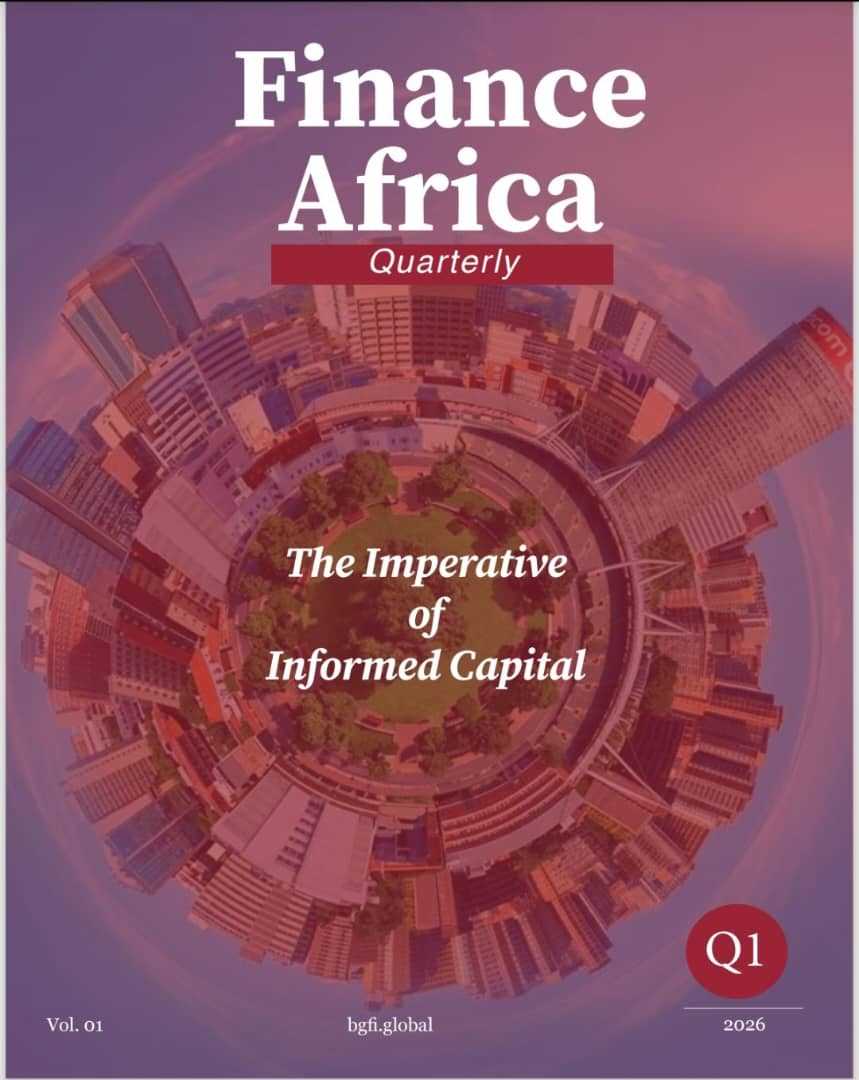
A new player has entered Africa’s financial intelligence landscape, seeking to reshape how global investors interpret the continent’s economic prospects.
The Bard Global Finance Institute (BGFI) has launched Finance Africa Quarterly, a publication positioned to challenge long-standing perceptions of Africa as a uniformly high-risk investment destination and instead highlight strategic opportunities emerging across its markets.
Rather than serving as a traditional economic magazine, the publication is designed to address what BGFI describes as a persistent information gap that has influenced global investment decisions for decades.
BGFI Publisher and Editor-in-Chief Shep Mphambela said the initiative was born from “a singular, compelling observation: the narrative surrounding African economic development and investment has long been characterised by profound information asymmetry.”
He noted that global capital has often viewed Africa through broad risk assumptions that obscure sector-specific opportunities capable of delivering significant returns.
“For decades, global capital has approached Africa through a lens of generalised risk, often overlooking the nuanced, sector-specific and highly lucrative opportunities that define the modern African economic landscape,” Mphambela said. “BGFI was established to bridge this critical knowledge gap.”
Through data-driven research and targeted sector analysis, Finance Africa Quarterly aims to move investment discourse beyond sweeping generalisations toward actionable intelligence tailored for institutional investors, policymakers and corporate decision-makers.
BGFI emphasises that its approach is not to dismiss the realities of frontier market risk but to place those risks within informed economic context.
Related Stories
“Our focus is not to minimise the risks inherent in frontier markets, but to contextualise them,” Mphambela said. “Informed capital is transformative capital.”
The magazine anchors BGFI’s broader knowledge ecosystem, which also includes The Africa Finance Insights and AfriFin Analytics, platforms expected to provide specialised thematic research and technical market analysis.
According to Mphambela, BGFI’s broader mandate is to interpret African economic developments and surface investable opportunities for global capital navigating increasingly complex markets.
The inaugural edition reflects this ambition, featuring analysis on Zimbabwe’s critical minerals financing landscape, Botswana’s evolving diamond industry, infrastructure constraints affecting technology entrants such as Starlink, and the transformation of corporate treasury functions across African economies.
“In this inaugural issue, we present a curated selection of insights that reflect the dynamic nature of African finance today,” Mphambela said, adding that the focus shifts from development narratives toward identifying “investable frontiers.”
BGFI operates under parent company Bard Santner Inc, which is regulated by the Securities and Exchange Commission of Zimbabwe and the Reserve Bank of Zimbabwe. The firm is positioning itself as an intermediary capable of influencing how capital is interpreted and deployed across African markets through advisory and asset management services.
Leadership at the institute reflects that strategic positioning. Chief executive Senziwani Sikhosana brings more than two decades of banking experience, while executive director Tatenda Hungwe contributes regional and international expertise spanning private equity and derivatives trading.
The launch of Finance Africa Quarterly represents more than a publishing debut. It signals an effort to redefine Africa’s investment identity by improving the quality, depth and credibility of financial intelligence shaping capital allocation decisions.
“We provide deep, reliable and incisive interpretations of fundamental and technical realities to help our readers make strategic, high-yield investments,” Mphambela said. “We invite investors and institutions alike to engage with these insights as we position ourselves as a trusted advisory partner in the African investment landscape.”





Leave Comments